Your new hire’s first order shouldn’t be a real one.
Simetta is a flight simulator for your ERP. Customer service, purchasing, warehouse and accounting staff practice on screens that look and behave like yours, get scored on every save, and learn what each mistake would have cost, before they touch the live system.
No signup. The lesson runs in your browser on a sample company.
Your first phone order
Maria A. · Customer Service 1 · accuracy 60%
An order was entered for Canadian River Plastics10 pts
Exactly one order was entered5 pts
The order is for UCF20815 pts
Quantity of UCF208 (each)20 pts
Required Date15 pts
Entered 03/02; the customer asked for 03/05. The warehouse picks by required date. A wrong date either rushes an order that could wait or misses the date the customer was promised.
Customer PO number15 pts
Left blank. Many customers’ AP departments reject invoices without their PO number. The invoice sits unpaid until someone chases it.
Unit price comes from the system10 pts
Typed over the system price. Overriding the system price bypasses contract and quantity-break pricing and is the most common source of margin leakage.
Ships from the customer’s usual location (OKC)10 pts
How most teams learn the ERP today
Scored the way Simetta scores a trainee: what happened, and what it costs.
Shadowing a coworker
The new hire learns one person’s habits, shortcuts included, and nobody checks what stuck.
Practicing in the live system
Every practice order is a real order someone has to find and cancel, and the real mistakes ship.
A test company
Stale data nobody resets, and no one grades the work, so “practice” means clicking around.
A signed training checklist
It proves they sat through it. It doesn’t prove they can take an order on credit hold.
Teach it, then test it with different data
Every skill runs the same loop. A score only counts when the person can do the task on a customer, item and document they have never seen.
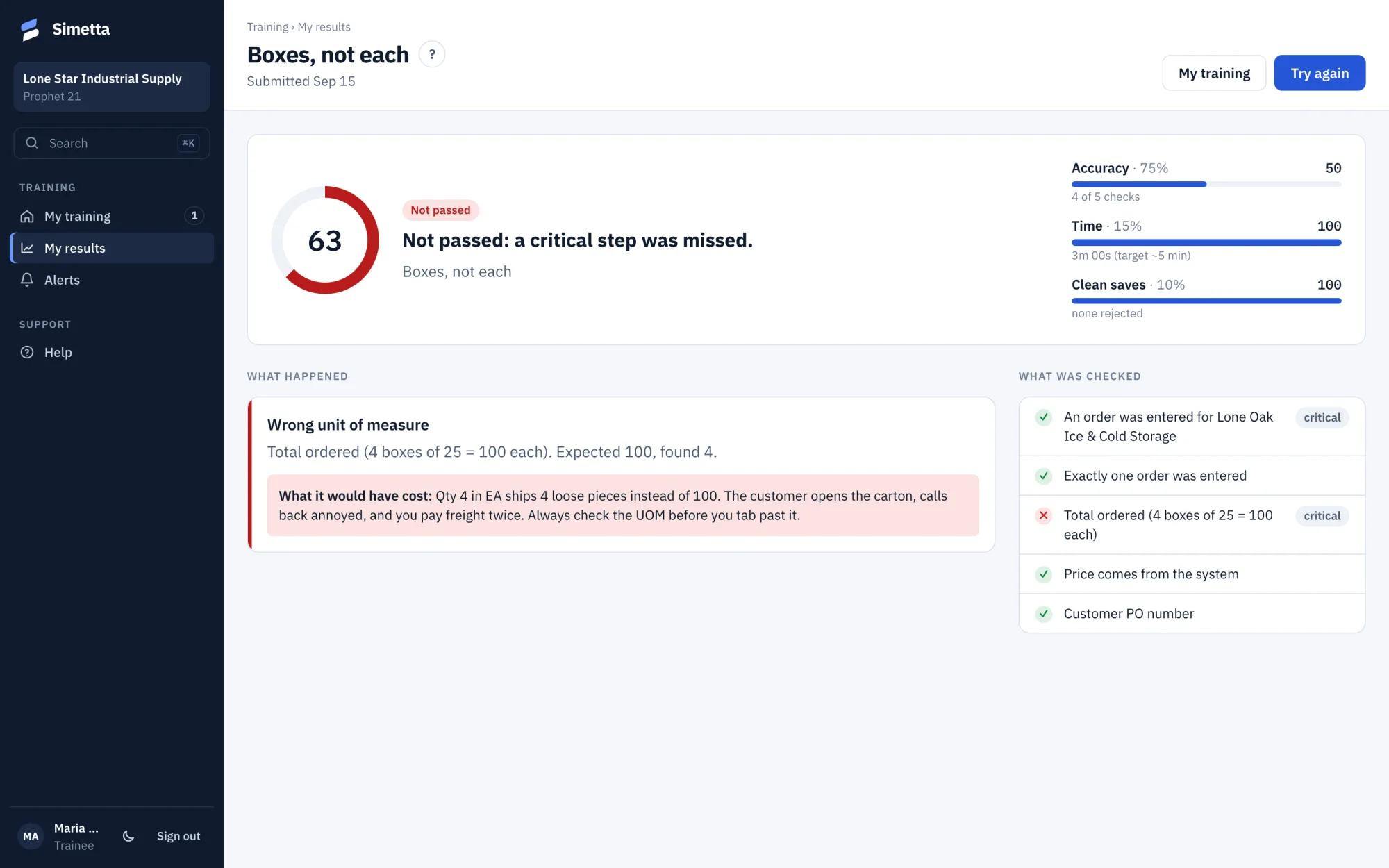
Lesson
A coach panel walks through the real screen one field at a time, says why each one matters, and can do a step while the trainee watches. The lesson only finishes when the work in the sandbox would pass the test.
Scored test
The same skill with a different customer, item and PO. No steps, hints cost points. Every save is checked, field by field, against what the task asked for.
Debrief
Each miss comes back in plain language: what was wrong, what was expected, and what it would have cost the business. Skills return for review after 1, 3, 7 and 21 days.
Module exam
A random draw of the module’s skills, each with fresh data. Passing it is what certifies the module.
A track for every desk
23 modules across the departments that live in the ERP all day. Each has a sample lesson you can play right now.
| Department | Modules | Sample lesson | Actions |
|---|---|---|---|
| Customer Service and Sales CSR · Inside Sales · Pricing | 9 modules, 38 skills Order entry, Tricky orders, Receiving for the front counter… | Take a phone order: the right customer, item, quantity, date and PO. | Play it |
| Purchasing Purchasing | 3 modules, 11 skills Vendors, suppliers and items, Buying, Inventory control… | Raise a PO to the right supplier, at the right cost, for the right branch. | Play it |
| Warehouse Warehouse | 3 modules, 11 skills Bins and adjustments, Transfers, Receiving and shipping… | Move stock off the receiving dock into the bins it belongs in. | Play it |
| Accounting AR · AP · GL | 8 modules, 32 skills Applying cash, Credit and billing, The three-way match… | Post a customer’s check to the invoices it pays. | Play it |
Know who’s ready before they’re on the phones
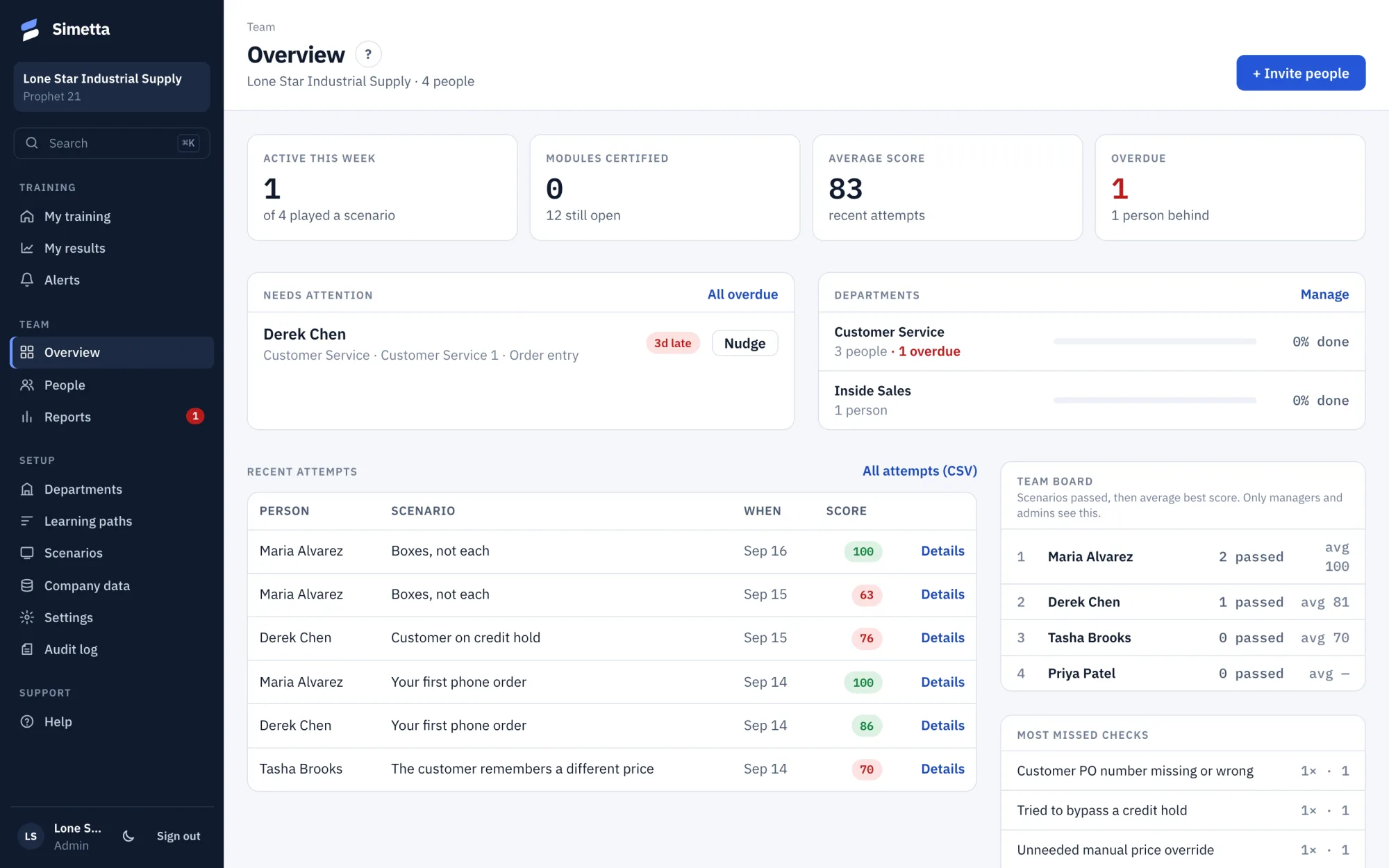
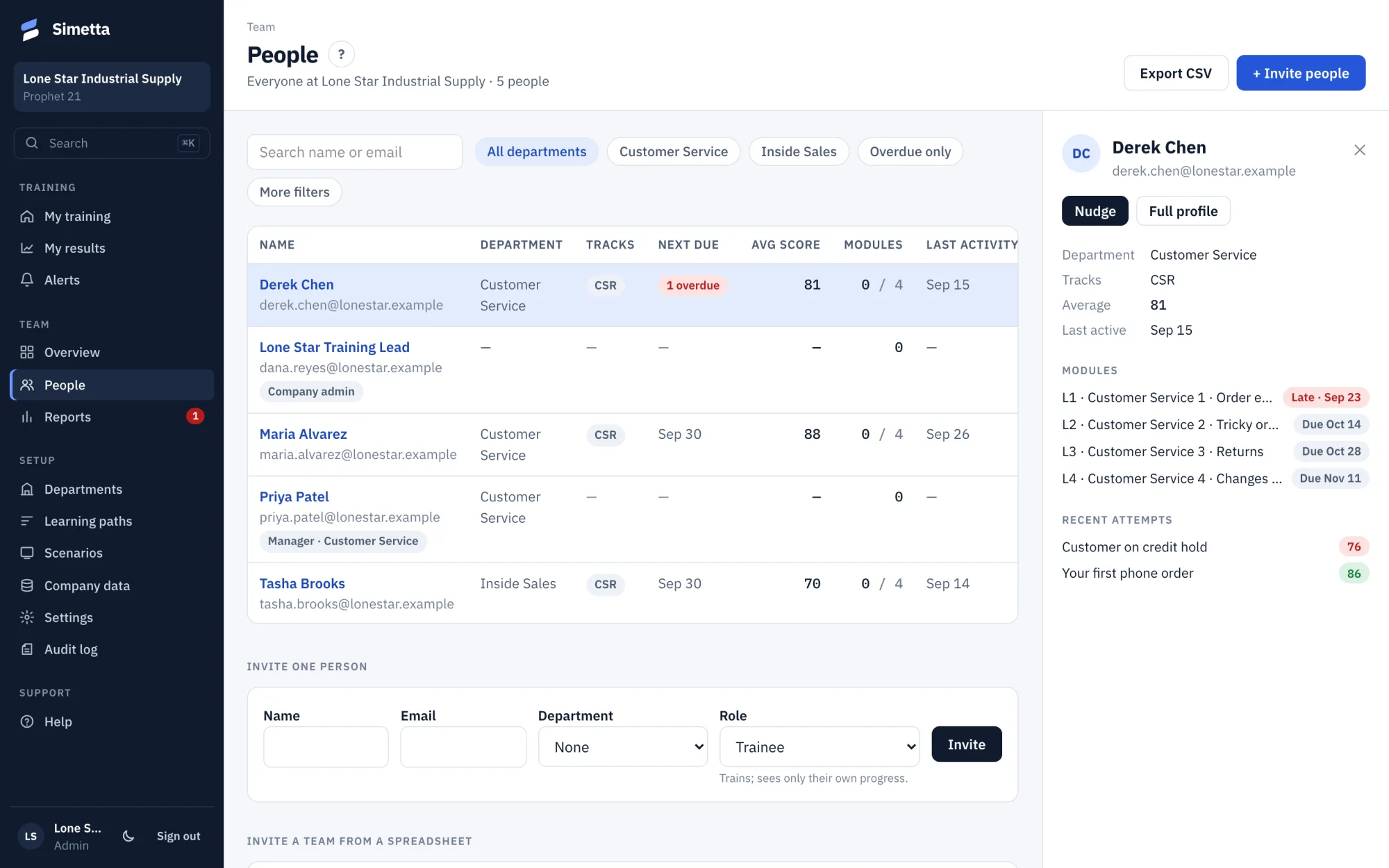
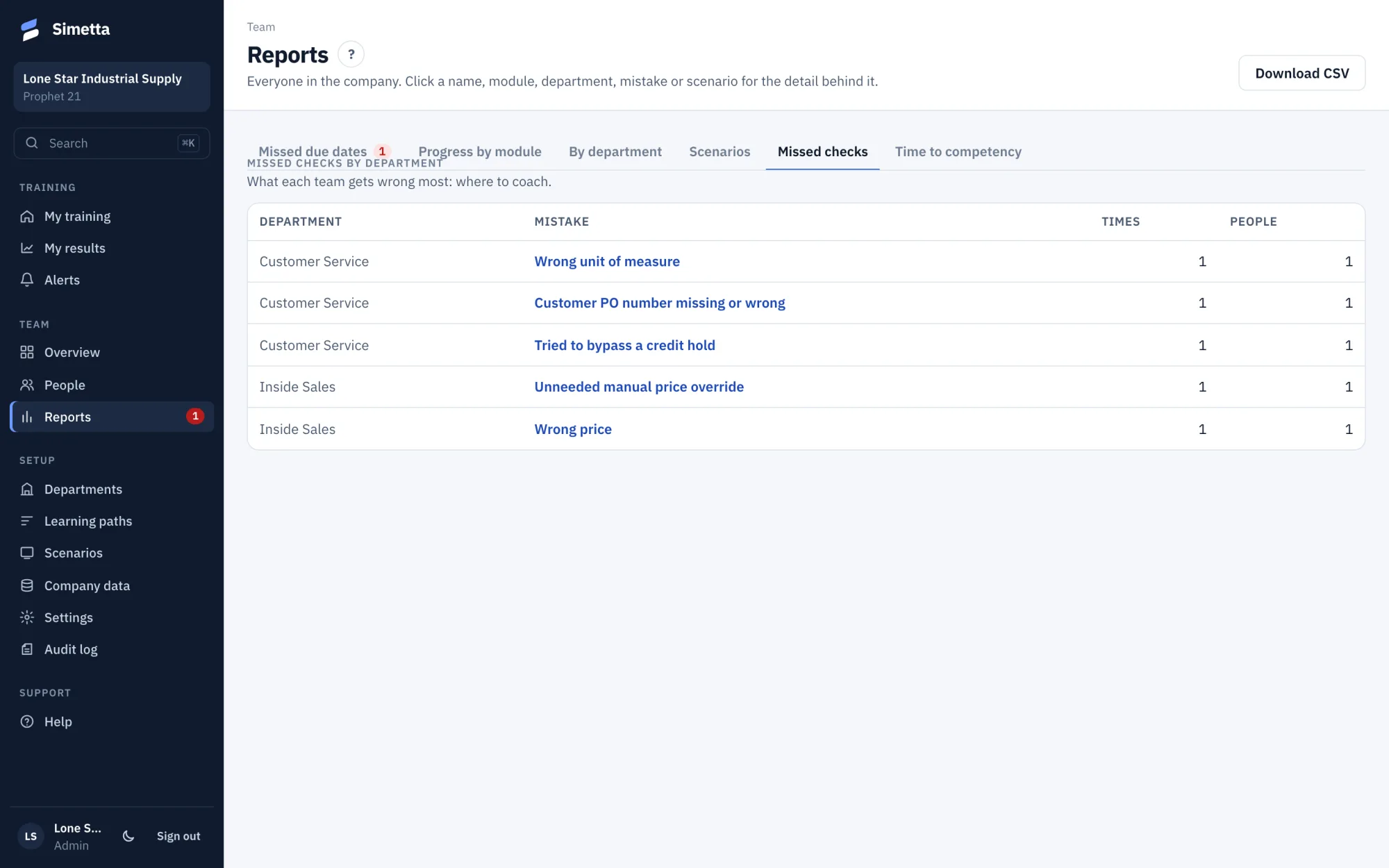
Managers assign tracks by department with due dates. The overview shows who is behind, what the team keeps getting wrong, and every attempt behind every score.
Needs attention
Overdue people, with a Nudge that sends an alert and an email.
Most missed checks
The mistakes your team makes most, ranked, with the attempts behind them.
Progress by module
Who has certified what, by department and due date.
Every attempt
Score, debrief and each save the trainee made, exportable to CSV.
Team skills checks
Test a whole department on a module, lessons or not, and see who can already do the work.
Your ERP’s screens. Your company’s data. None of your risk.
The screens follow your ERP’s labels, tabs and grids, so what people learn transfers on day one. Underneath is one business-rules engine: credit holds, contract and quantity-break pricing, allocation, terms discounts and the three-way match all behave the way they do in real life.
- Ready
Prophet 21 screens
Order Entry to month-end: the P21 windows your people use most, rebuilt as a training simulation.
Simetta for Prophet 21 - Coming
More ERPs
In development. Each ERP is a new set of screens over the same engine and the same lessons.
- Ready
Your own data
Load your customers, items, vendors and stock from a spreadsheet, so practice uses names from your own business.
- Ready
Live system untouched
The sandbox is its own copy with its own engine. It resets for every attempt.
Questions
What is Simetta?
Simetta is a training simulator for ERP work at distributors and manufacturers. Employees practice real tasks, such as entering a sales order, receiving a PO or posting a customer payment, on screens that look and behave like their ERP. Each attempt is scored, and a debrief explains what went wrong and what it would have cost.
Does Simetta connect to our live ERP?
No. Trainees work in a sandbox with its own business-rules engine. Nothing they do reaches your live system, so a mistake in training costs nothing.
How is this different from training videos or a test company?
Videos show the task but can’t check the work. A test company lets people practice but nobody resets it, the data goes stale, and nobody scores the result. Simetta resets itself, gives each attempt different data, and checks the work against the task, field by field. The comparison pages go through each alternative in detail.
Can the practice data look like our business?
Yes. Simetta ships with a demo company, and you can import your own customers, items, vendors and stock from a spreadsheet so trainees practice on names they will see on day one.
Which ERPs does Simetta support?
Epicor Prophet 21 (P21) today. The simulator is built so each ERP is a new set of screens over the same engine, and more ERPs are in development.
What do managers see?
A team overview with who is behind and a one-click reminder, team skills checks that test a whole department on a module, progress by department and module, scores and debriefs for every attempt, the checks people miss most, time to competency, and CSV export.
How is Simetta priced?
Two ways. Per person, for companies that hire occasionally: each person trained gets 90 days of every track. Or yearly, for unlimited training and team skills checks, priced by how many people use your ERP. There is a one-time setup fee to load your data. See the pricing page for the numbers.
How long does a lesson take?
Most skills take five to ten minutes: a guided lesson, then a scored test on the same skill with different data. Each module ends with an exam that draws several skills at random.
Five minutes on the demo will tell you more than this page can.
Play a real lesson, take the scored test, then see what your manager would see.